




Drugs and dietary supplements: what are the differences?
Drugs and supplements food are useful allies for the overall health and well-being of our bodies; although they have distinctive and specific characteristics, we often use these terms as synonyms: so what are the differences?
Drugs and dietary supplements: definitions
It may happen that the component of a drug is the same as that of a dietary supplement; the question then arises: what is the difference between medicines and supplements?
A drug is defined as that “substance or combination of substances presented as having curative or prophylactic properties of human diseases”; a supplement, on the other hand, has the function of supplying the diet with substances that, in a given period or situation, can support normal physiological functions but without any therapeutic activity.
Supplements constitute, therefore, a concentrated source of nutrients, such as vitamins and minerals; often, dietary supplements containing amino acids, essential fatty acids, probiotics, fiber, and extracts of plant origin are on the market, either alone or in combination with each other and in predosed forms such as capsules, tablets, sachets, or vials.1
The supplement originates as a food whose safety, quality and non-toxicity is guaranteed; however, a supplement will not be able to claim therapeutic properties, it cannot prevent or cure any disease.1
Drugs and supplements are therefore subject to different regulations. For example, the medicine must meet the characteristics stipulated in the monograph of the Official Pharmacopoeia or the dossier filed for the registration of the medicine with the Medicines Agencies (in Italy AIFA).1
Instead, the efficacy of supplements is evaluated by the manufacturing company, possibly including studies, while the product is notified to the Ministry of Health.
Differences between drugs and supplements
The authorization process leading to their marketing, consumer information, distribution channels (supermarkets rather than pharmacies) and, in general, European and Italian regulations consider supplements in the same way as “foods”; in fact they respond to different rules from those applied to drugs.
The European Commission has identified the following criteria for defining a supplement:1
- A product intended for the general population that is healthy or has a risk factor for disease development;
- A product whose consumption promotes the maintenance of a physiological function of the body or the reduction of a risk factor;
- a product that cannot claim preventive and therapeutic effects toward a disease condition;
- a product connoted by nutrition and health claims proposed on labels and/or with advertising in accordance with current EU regulations in this area.
Another element used to distinguish whether it is a supplement or a drug is the dosage of the substance used.
In the case of vitamin B12 for example, preparations of this substance-when sold in forms that allow the maximum daily dosage of 1,000 mcg-are classified as supplements and can claim the property of promoting normal red blood cell formation; whereas, preparations available in forms that allow a daily dosage of more than 1000 mcg are considered drugs, with the therapeutic indication of treatment of megaloblastic anemia.1
The supplement and the well-being of the person

As mentioned above, the Italian Ministry of Health defines supplements as
“foodstuffs intended to supplement the common diet and constituting a concentrated source of nutrients, such as vitamins and minerals, or other substances having a nutritional or physiological effect, particularly but not exclusively amino acids, essential fatty acids, fiber, and extracts of plant origin, whether mono- or pluricompounded, in pre-dosed forms.”2
The drug and the treatment of diseases
Different are the claims for a drug, which must prove not only that it is safe but also effective, so in order to obtain a marketing authorization, the relevant agency (EMA for European authorizations and AIFA for Italian ones) evaluates not only efficacy and safety but also manufacturing quality.4
In particular, when it comes to drugs, it should be remembered that they are on the market in different forms, in particular:
- Drugs prepared in pharmacies, so-called galenic preparations;
- Drugs of industrial origin, which include specialty medicines and industrial galenics that are not prepackaged.
- Class A, reimbursed by the health care system. These are normally essential and chronic disease drugs; within the drugs reimbursable by the health system, Band H identifies products reimbursed for their use only within the hospital;
- Class C, drugs not reimbursed by the health care system. These may still be subject to prescription; in the case of self-medication drugs, advertising to the public is also permitted.
A special note concerns the issue of interactions between drugs and supplements, some even for widely used nutritional ingredients.6
Therefore, before taking a supplement, you should always talk to your physician for professional advice on possible interactions.
How many types of supplements are there?
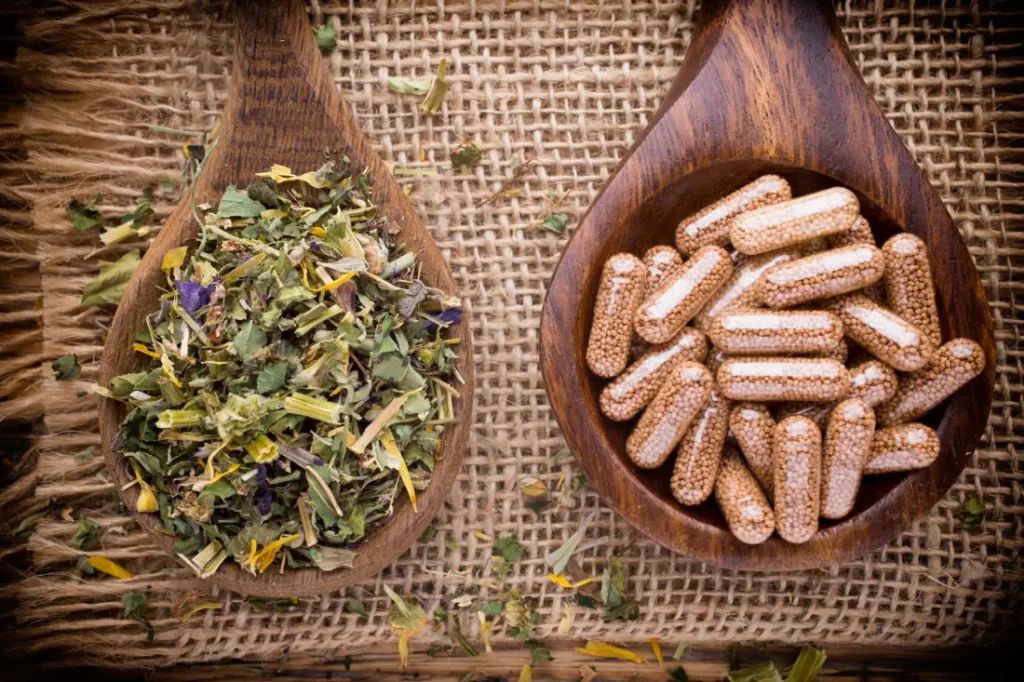
The huge world of supplements can be divided into categories regarding the area of use (energy metabolism, nervous system functioning, immune system functioning, etc.) but also with regard to the substances used within the supplement.
- vitamins and minerals, for which there are maximum allowable intake levels;
- probiotics and prebiotics, where there are specific provisions for such substances with “physiological” effect;
- Other substances with nutritional or physiological effect, where various provisions for other nutrients and other substances with nutritional or physiological effect are given;
- plant substances and preparations (Botanicals) where plants that can be used for their physiological effect are listed.
The regulations also take into account the possibility of dietary supplements being presented as adjuvants to low-calorie diets and specific legislation references the use of botanicals as well as any novel ingredients or food products (“novel foods“) whose use requires prior authorization at the European level.7
In conclusion, supplements and drugs are characterized by numerous differences that need to be taken into account to best support the well-being of our body.
Bibliography
- Cometa MF, et al; ISS Working Group COVID-19 Drugs. Dietary supplements or drugs? Regulation and recommendations for informed use in COVID-19 time. Disponibile online: https://www.iss.it/documents/20126/0/Rapporto+ISS+COVID-19+51_2020.pdf/01dcd756-8cce-0b08-6573-be67872cded1?t=1592838400233; ultimo accesso: 17/11/2023.
- LEGISLATIVE DECREE May 21, 2004, no. 169. Implementation of Directive 2002/46/EC on food supplements.
- Efsa. List of permitted health claims
- Aifa. National authorization procedure. Available online: https://www.aifa.gov.it/web/guest/procedura-di-autorizzazione-nazionale; last accessed: 17/11/2023.
- Aifa. Drug supply regime. Available online: https://www.aifa.gov.it/regime-di-fornitura-dei-farmaci; last accessed: 17/11/2023.
- Merck manual of diagnosis and therapy. Table possible drug interactions of some dietary supplements. Accessed online: https://www.msdmanuals.com/it-it/professionale/multimedia/table/possibili-interazioni-farmacologiche-di-alcuni-integratori-dietetici. Last accessed: 15/10/2023
- Ministry of Health. Dietary supplements and Ministerial Guidelines (LGM). Available online: https://www.salute.gov.it/portale/temi/p2_6.jsp?lingua=italiano&id=1267&area=Alimenti%20particolari%20e%20integratori&menu=integratori; last accessed: 17/11/2023.
The best supplements for every need
La Principium line adopts all these measures: a main active at high dosages, in synergy with other substances that enhance its effectiveness combined with the best production technologies.